Change order construction: what contractors must do first

A change order is a written, contract-backed amendment that records agreed changes to a project’s scope, cost or time. The moment one lands on your desk, three things matter more than anything else in the contract.
First, give notice in writing, even if the client rang you and said “just do it.” Second, preserve evidence before the work starts, not after. Third, stop non-contract work or formally reserve your position on time until you have a signed instruction.
- Notify the contract administrator or client in writing, referencing the specific clause that requires it.
- Preserve evidence: photograph the site, log dates, and keep RFIs and drawings tied to the event.
- Reserve or stop: don’t proceed with unpriced work without flagging that time and cost are unresolved.
Get this wrong and the commercial consequences are real. Industry estimates suggest roughly a third of construction projects experience at least one major change, and the Associated General Contractors of America warns that slow change order approval, particularly on public contracts, is a common driver of cash-flow strain and project delay.
Key Takeaways
Getting paid for a change order construction event depends on giving prompt written notice, separating cost from time, and proving entitlement, causation, and quantum with contemporaneous records.
| Point | Details |
|---|---|
| Notify in writing immediately | Verbal instructions don’t protect payment; confirm every change order trigger in writing within the contract’s notice window. |
| Separate cost from time | Price scope changes and time-related costs independently, and state whether time is agreed, neutral, or reserved. |
| Prove all three elements | Entitlement, causation, and quantum must each be demonstrable before a change order will hold up under scrutiny. |
| Match the document to the moment | Use an RFI for clarification, a COR to request pricing, and only proceed under a CCD while tracking costs separately. |
| Capture evidence at the point of work | Tools like Tradesmith let tradespeople voice-record change details and evidence on site, feeding straight into quotes and invoices. |
Table of Contents
- Change order construction terminology every professional should know
- Why change orders happen so often on construction sites
- Types of change order and how the contract shapes them
- The change order process, step by step
- How to value a change order: entitlement, causation, quantum
- Contract clauses and notice windows to check before you price anything
- Managing disputes and claims when a change order is contested
- RFI, COR, or CCD: choosing the right document
- Frequently asked questions about change order construction
- Sources
Change order construction terminology every professional should know
The industry uses several overlapping terms, and mixing them up costs money. A change order is the final, agreed document: signed, priced, and binding on both parties. A variation is the same thing under a different name, common in UK, Australian, and NEC-style contracts. Americans and contracts drafted under AIA-style forms tend to say “change order”; British and Commonwealth contracts often say “variation.” The Wikipedia entry on change orders confirms the terminology genuinely varies by region rather than by substance.
A change order request (COR) is a proposal, not yet agreed: your priced offer to do extra work, sitting on the client’s desk awaiting a signature. A construction change directive (CCD) is different again. It’s an instruction to proceed issued by the owner or architect before price or time is settled, usually because stopping work would cost more than the dispute over value.
Here’s where people trip up: a COR you submit is not a change order until it’s signed. A CCD you receive is not a change order either. It’s an instruction to get on with it, with the commercial terms to follow. Treat each differently. A signed change order protects your payment position. A pending COR protects nothing until it’s countersigned. A CCD requires you to keep separate cost records because you’re working on trust that fair value will follow.
Why change orders happen so often on construction sites
Most changes trace back to a handful of recurring causes, and spotting the pattern early lets you price and document faster.
- Design omissions or errors (OMIs): a detail missing from drawings, discovered mid-build.
- Unforeseen site conditions: concealed rock, contaminated ground, or services not shown on utility drawings.
- Owner-instructed changes: a client upgrading finishes, adding a room, or changing a specification mid-project.
- Regulatory or code changes: new fire safety or accessibility requirements introduced after design freeze.
- Supply-chain substitutions: a specified product goes out of stock, forcing an equivalent swap.
- Value engineering: a contractor proposes a cheaper or faster method that alters the original scope.
- Weather and force majeure: exceptional conditions that delay or alter sequencing.
Concealed rock is the classic example: a groundworks contractor hits bedrock two metres down where the geotechnical survey promised clay. That’s an unforeseen condition, and it’s usually a strong basis for a change order provided you notify promptly and keep dated photographs.
Types of change order and how the contract shapes them
Four distinct categories cover almost every change you’ll encounter, and each carries a different commercial risk profile.
An additive change increases scope and value, typically the easiest to agree because everyone benefits from clarity. A deductive change removes scope and reduces contract value, and these often generate more friction than additions because contractors lose margin they’d already planned around. A substitution swaps one product or method for another of broadly equal value, sometimes cost-neutral, sometimes not. A constructive change is the trickiest: the owner’s actions or instructions effectively force a change without anyone formally acknowledging it as one, often through delayed approvals, extra inspections, or informal direction from site staff.
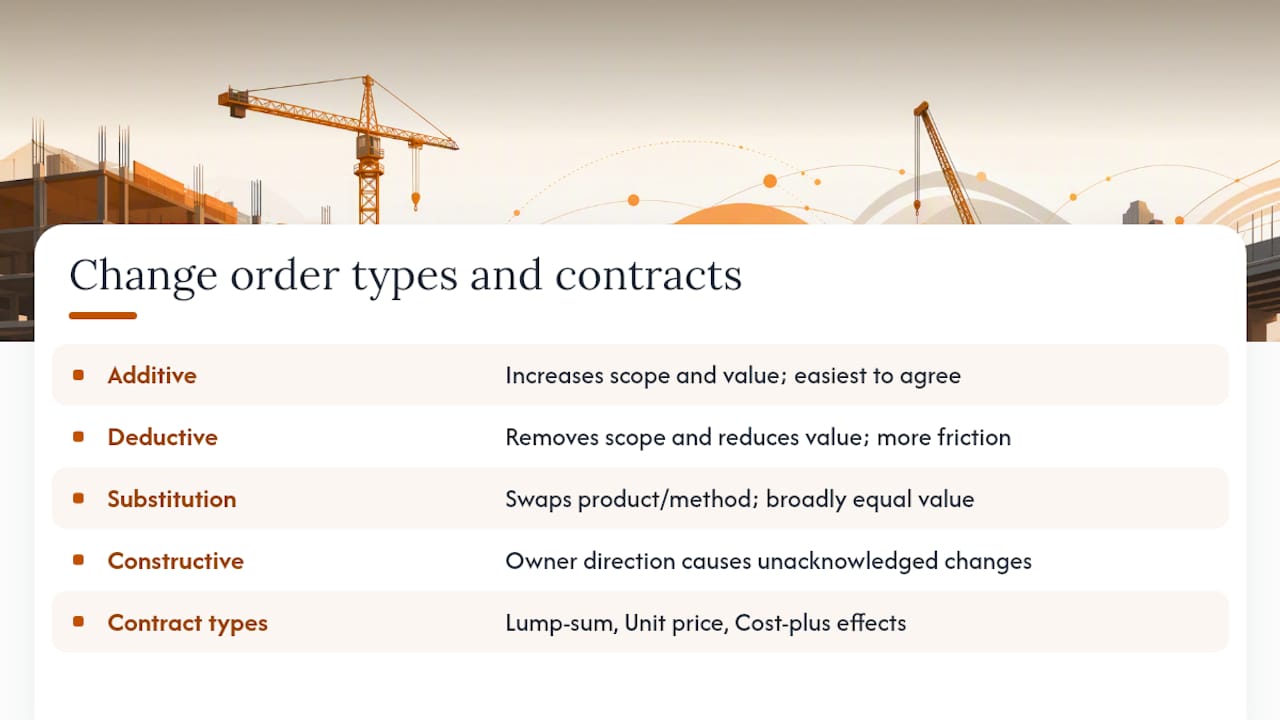
Contract type changes how these play out. A lump sum contract requires a fully priced change order before instructed work proceeds, or you carry the cost risk yourself. A unit price contract often has agreed rates already built in, so pricing is faster but disputes shift to quantities instead of rates. Cost-plus contracts make valuation simpler but invite more scrutiny of markup. NEC contracts use compensation events with strict notification windows; JCT and FIDIC forms use variation instructions with named certifiers. Owner-directed changes under a CCD are the most likely to end in dispute, because you’re building before the money is settled.
The change order process, step by step
A change order that gets approved fast follows the same sequence every time, whether it’s a £2,000 substitution or a £200,000 scope addition.
- Identification: someone spots the trigger. A site supervisor finds concealed services, an architect issues a revised drawing, a client asks for an upgrade.
- Notice: written notification to the contract administrator, referencing the relevant clause, sent within whatever window the contract sets.
- Preliminary assessment: a rough scope and cost impact, enough to decide whether it’s worth pursuing formally.
- Detailed quotation: a fully priced breakdown covering labour, materials, plant, overheads, and profit, plus any time effect.
- Submission: the formal change order request goes to the certifier, architect, or client representative.
- Negotiation and approval: back-and-forth on price or scope until both sides agree, or a directive is issued to proceed regardless.
- Execution: work begins under the signed order, not before, wherever avoidable.
- Close-out: the change is reconciled into the final account, and records are archived.
A change order form needs specific fields to survive scrutiny later. At minimum, include a reference number linked to the original contract, the date of the event and the date of submission, a full description of the change and its trigger, a detailed cost build-up (labour, materials, plant, overheads, profit), the schedule impact in days, the updated contract sum, and signature blocks for both parties. Link supporting documents directly: drawings, RFIs, and the site instruction that triggered it.
Evidence wins or loses these arguments months later, not on the day. Keep dated photographs of the condition before and after, a site diary entry noting who instructed what and when, the RFI log tied to the event, and copies of any verbal instructions confirmed in writing afterwards. A structured approach to crew scheduling also helps here, because a change that shifts sequencing or adds trades needs the workforce plan updated at the same time the change order is raised, not after.

Pro Tip: Never let site staff verbally agree to “just get it done” without a paper trail. Insist that whoever has signing authority under the contract confirms in writing before extra work starts, even a one-line email. It costs you nothing and it’s the difference between getting paid and arguing about it in adjudication.
How to value a change order: entitlement, causation, quantum
Every change order valuation rests on three tests, and the AACE International recommended practice sets them out clearly: entitlement, causation, and quantum.
Entitlement asks whether the contract actually gives you the right to be paid for this. Was the event outside your original scope, or something you should reasonably have allowed for? Causation asks whether you can draw a clear line from the triggering event to the cost or delay you’re claiming. Quantum asks whether the amount you’re claiming is reasonable and supportable with real records, not estimates pulled from thin air.
Pricing methods vary by situation:
- Lump sum quotation: a fixed price agreed before work starts, best for clearly defined additions.
- Dayworks or time and materials: hourly rates plus material cost, used when scope is unclear at the outset.
- Measured or quantified method: applying agreed unit rates to actual quantities, common under unit-price contracts.
- Cost-plus: actual cost plus an agreed markup, typically 10 to 15% for overhead and profit on the change value, a range Autodesk’s guidance flags as standard practice.
A worked example makes this concrete. Say a client asks for an upgraded kitchen worktop mid-build, a straightforward substitution. Material cost rises by £1,800. Labour to fit the heavier stone adds four hours at £35 an hour, or £140. Overhead and profit at 12% on the combined £1,940 adds £233. Total change order value: £2,173. No time impact, because the trade sequence absorbs the extra hours without delaying the next crew.
Time consequences need separate treatment from cost. If a change genuinely extends the critical path, calculate prolongation costs (site overheads, extended plant hire) separately from the direct scope cost, and state clearly whether the extension is agreed, disputed, or reserved for later determination.
Pro Tip: Always write down your assumptions on the change order itself, not just the number. State explicitly whether the time position is “agreed”, “neutral” (no impact), or “reserved” (to be determined later). Silence on time gets read against you every time.
Contract clauses and notice windows to check before you price anything
Before you price a single change, find five things in the contract, because getting any of these wrong can forfeit your entitlement entirely.
- The change or variation clause itself, which defines what counts as a change and who can instruct one.
- The notice clause, which sets the deadline for flagging a change, often expressed in calendar days from the triggering event.
- Time extension provisions, covering how and when you can claim additional time.
- Payment and application formats, specifying how change order values get included in interim applications.
- The authorised signatory list, confirming exactly who on the client side can approve a change order.
- The dispute resolution path, in case the change is contested.
Notice windows vary widely by contract, from 7 to 28 days in common forms, and missing that window can forfeit payment entirely regardless of how clearly the change occurred. Proceeding on a verbal instruction without a signed order is the single most common way contractors lose these arguments, because the person who told you to “just get on with it” often isn’t the person with authority to bind the contract.
Managing disputes and claims when a change order is contested
Avoidance beats resolution every time. Record everything contemporaneously, follow notice deadlines to the letter even when they feel bureaucratic, and never let a directive substitute for a signed price agreement without separately tracking your costs.
When a change order is rejected outright, act fast. Record your disagreement in writing immediately, stating why you believe entitlement exists. Preserve all cost records as if the claim will eventually need independent scrutiny. If the rejection also causes delay, issue a formal notice of delay separately from the cost dispute, because the two claims often follow different contractual paths.
Escalation typically runs through three stages. First, internal review between commercial teams on both sides, often resolving the bulk of disputes without formal process. Second, a determination by the architect or engineer named as certifier under the contract, which carries contractual weight even if either party disagrees. Third, formal adjudication or arbitration, reserved for genuinely contested value or entitlement that the certifier’s determination hasn’t resolved. Each stage takes longer and costs more, which is exactly why the paper trail from stage one matters so much later.
RFI, COR, or CCD: choosing the right document
| Purpose | Who acts first | |
|---|---|---|
| RFI | Seeks clarification or information, no cost implication | Contractor requests, designer answers |
| COR / change proposal | Requests pricing agreement before work proceeds | Contractor proposes, client approves |
| CCD / directive | Instructs work to proceed before price or time is settled | Owner instructs, contractor complies and tracks cost |
If you’re asked to proceed under a directive before commercial terms are agreed, record cost separately from day one and confirm in writing that value remains open for later agreement.
What actually saves you money on change orders
Three habits do more work than any contract clause: keep a single-page change log updated daily, not weekly; pre-agree unit rates for recurring items like additional glazing or electrical points before the project even starts; and never let work begin on a directive without a written note confirming the commercial terms remain open. On one job, a pre-agreed rate sheet turned a potential three-week pricing standoff into a same-day sign-off.
Capturing change orders without losing an evening to paperwork
The hardest part of managing a change order construction workflow isn’t the pricing logic, it’s capturing the evidence and the paperwork at the moment the change actually happens, on site, often with muddy hands and a client waiting for an answer.

Tradesmith was built for exactly that moment. Voice-dictate the change on site, the description, the trigger, the extra materials, and it turns into a structured record without you typing a word standing in a doorway. Because quoting and invoicing sit in the same app, a priced change order flows straight into an updated invoice instead of getting lost in a notebook until month-end. Try Tradesmith’s 14-day free trial and see whether it cuts the gap between “the client asked for this” and “the client’s been billed for it.”
Frequently asked questions about change order construction
What is a change order in construction? It’s a written, contract-backed document that formally amends the original contract’s scope, cost, or time, agreed and signed by both parties before or alongside the work it covers.
Is a change order legally binding? Yes, once signed by the parties with authority under the contract. An unsigned change order request or a verbal instruction generally carries far weaker legal standing.
Who can approve a change order? This depends entirely on the contract’s authorised signatory list, usually the architect, engineer, or a named project representative, never assume site staff have signing authority.
How long do I have to submit a change order notice? Notice windows vary by contract, often between 7 and 28 days from the triggering event, and missing the deadline can forfeit your right to payment or time relief.
What’s the difference between a change order and a variation? None commercially, they’re the same document under different regional naming conventions, with “variation” more common in UK and NEC-style contracts.
Sources
- 100R-19: Contract Change Management – As Applied in Engineering, Procurement, and Construction
- How Change Orders Work in Construction | Procore
- What Are Change Orders in Construction? | Blog | Autodesk
- Change Orders | Associated General Contractors of America