What every UK invoice must legally include

A UK invoice must show a unique sequential number, your name and address, the customer’s name and address, a clear description of the goods or services, the supply date, the invoice date, itemised amounts, and the VAT amount and total where VAT applies. That is the baseline for every business, sole trader or limited company, VAT registered or not.
A full VAT invoice becomes mandatory when you sell to another VAT-registered business (B2B), because your customer needs it to reclaim input tax. Sell to the general public and a simpler receipt often suffices, though it is still good practice to itemise everything.
Two other numbers to keep in your head:
- A maximum of one month: issue your invoice promptly after the supply date, or after the payment date if earlier, according to Gov.
- Several years — you must retain VAT invoices and records for a legally specified extended period, including electronic copies.
Everything below unpacks these rules field by field, with the statutory backing and the practical shortcuts that stop you falling foul of HMRC or chasing a client who’s rejected your invoice on a technicality.
Key Takeaways
Meeting UK invoice requirements means combining the statutory fields in regulation 14 with disciplined sequential numbering, correct VAT treatment, and six-year record retention.
| Point | Details |
|---|---|
| Mandatory fields | Every invoice needs a sequential number, supplier and customer details, description, supply date, invoice date, and totals. |
| Full VAT invoice trigger | Required for B2B sales where both parties are VAT registered, per regulation 14 particulars. |
| 30-day issuance rule | Issue within 30 days of the supply date or an earlier payment date, whichever comes first. |
| Six-year retention | Keep VAT invoices and records, paper or electronic, for six years for HMRC inspection. |
| Foreign currency handling | Convert and show the VAT payable in GBP even when the rest of the invoice uses another currency. |
Table of Contents
- Invoice requirements UK: the mandatory fields explained
- VAT invoice rules: full, simplified and modified formats
- Timing rules, pre-supply documents and foreign currency invoicing
- Record keeping, electronic invoices and Making Tax Digital
- Common invoicing mistakes and a pre-send checklist
- How tradespeople actually stay compliant on site
- Where to check the exact rules yourself
- The compliance gap nobody talks about
- Frequently asked questions
- Sources
Invoice requirements UK: the mandatory fields explained
Get the fields wrong and you either delay payment or trip an HMRC query. Here’s what each one actually needs to say, with the sole trader and limited company differences spelled out.
-
A unique, sequential invoice number. Skip a number or reuse one and you create a gap that looks like a missing sale during a VAT inspection. Most tradespeople start at 001 and let their invoicing software increment automatically. Never manually renumber to “fix” a mistake. Void the invoice and issue a fresh one instead.
-
Your business identity. A sole trader must show their trading name (or full personal name if trading under their own name) and business address. A limited company must show its registered company name exactly as it appears at Companies House, plus its Company Registration Number (CRN) if the invoice is on formal company stationery. If a director’s name appears anywhere on the letterhead, list every director. Half measures invite questions.
-
Customer name and address. Full legal name of the business or individual you billed, not a shortened trading name that doesn’t match your contract.
-
Description of the work. “Bathroom refit” tells HMRC nothing and tells your customer even less. “Supply and fit of shower enclosure, 2 x radiators, first-fix plumbing, 14 to 16 March” gives both parties something to check against.
-
Supply date versus invoice date. The supply date (the “time of supply” or tax point) is when the work was actually completed, or the date of an earlier payment. The invoice date is when you raise the paperwork. These can differ, and both must appear separately.
-
Line items. Quantity, unit price excluding VAT, the VAT rate applied, the VAT amount, and the line total. Add a subtotal, VAT total, and grand total at the bottom.
Where VAT applies, your VAT registration number (VRN) sits near your business details, typically in the header.
VAT invoice rules: full, simplified and modified formats
Under regulation 14 of the VAT regulations, a full VAT invoice must carry statutory particulars that go beyond the basics: a sequential number uniquely identifying the document, the time of supply, the date of issue, your name, address and VRN, the customer’s name and address, a description of the goods or services, the quantity and unit price, the VAT rate for each item, and the total VAT chargeable expressed in sterling.
You need a full VAT invoice whenever the sale is B2B and both parties are VAT registered. If you’re ever unsure whether the customer needs one, Stripe’s HMRC-consistent guidance recommends defaulting to a full invoice rather than a simplified one.
Three scenarios worth flagging:
- Reverse charge supplies (common in construction under the domestic reverse charge) need a note stating “reverse charge: customer to account for VAT” instead of charging VAT yourself.
- Margin schemes, used for certain second-hand goods, require a note that the margin scheme has been applied rather than showing standard VAT.
- Simplified invoices are permitted for sales up to £250 including VAT and can drop the customer’s address and the separate VAT amount per line, showing only the VAT-inclusive total and rate.
- Modified invoices, used mainly for retail supplies over £250, show the VAT-inclusive total rather than breaking VAT out separately, subject to customer agreement.
Where a full VAT invoice is required, the total VAT payable must always be shown in pounds sterling, even if the rest of the invoice is in another currency. That single line is the one HMRC checks first.
Timing rules, pre-supply documents and foreign currency invoicing
The 30-day rule is simple in principle and easy to get wrong in practice: issue your invoice within 30 days of the supply date, or the payment date if you were paid before finishing the job. Finish a boiler install on 3 March and invoice on 2 April, you’re compliant. Leave it until 10 April, you’re not, even if the client hasn’t chased you.
A few situations catch people out:
- If you send a quote, estimate, or job sheet that happens to contain every invoice detail, HMRC can treat it as a VAT invoice by default. Endorse any pre-supply paperwork with the words “This is not a VAT invoice” to avoid creating an accidental, premature tax point.
- Invoicing in euros or dollars for an overseas client doesn’t exempt you from sterling reporting. The VAT amount must still be converted and shown in GBP, using an HMRC-acceptable method such as the period rate, the market selling rate at the time of supply, or another commercially recognised rate, per HSBC’s business guidance.
- Invoices can be issued in another language, but HMRC expects you to be able to provide an English translation within 30 days of a request, which matters if you subcontract for international clients.
- Northern Ireland traders dealing in goods (not services) with the EU should check the separate protocol rules that sit alongside standard VAT invoicing, since goods movements are treated differently from the rest of the UK.
Record keeping, electronic invoices and Making Tax Digital
VAT-registered businesses must keep invoices and related VAT records for six years, whether paper or digital. That covers sales invoices, purchase invoices, credit notes, and the working papers behind your VAT returns.
Electronic invoices are entirely acceptable, provided you can guarantee their authenticity (proof of who issued it), integrity (proof it hasn’t been altered), and legibility (readable for the full retention period). A PDF sitting in a folder that could be edited without a trace doesn’t meet that bar.
- Log the exchange rate and method used for any foreign-currency invoice alongside the invoice itself, not just the converted total.
- Export VAT summaries in a format compatible with Making Tax Digital rather than retyping figures manually each quarter.
- Keep credit notes and cancelled invoices, not just the ones that got paid. HMRC wants the full trail.
Pro Tip: Screenshot or save the exchange rate source you used at the time of invoicing, not the rate you look up months later when preparing your return. Rates move daily, and HMRC wants the rate that applied on the day.
Common invoicing mistakes and a pre-send checklist
Most invoice disputes and HMRC queries trace back to the same handful of errors.
- Non-sequential or duplicated numbers. A gap in your sequence looks like undeclared income; a repeat number looks like a duplicate claim.
- Wrong VAT treatment. Charging standard VAT on a reverse-charge job, or forgetting your VRN entirely, are the two most common flags in a VAT inspection.
- Tax point confusion. Using the invoice date where the supply date should appear understates or overstates the VAT period the sale belongs to.
- Vague descriptions. “Materials and labour” without a breakdown gives a client’s accounts team a reason to sit on payment while they query it.
Before you send anything, run through this in under a minute:
- Invoice number follows on from the last one, no gaps
- Supply date and invoice date are both shown and correct
- Customer name matches the contract, not a nickname or shortened trading name
- Every line has a quantity, unit price, and VAT rate
- VAT total and grand total are shown in GBP
- Payment terms are stated, even though a due date isn’t legally mandatory. A stated 7 or 14-day term beats the default 30-day fallback for cash flow.
Pro Tip: Keep a simple invoice log, even a spreadsheet, cross-referencing every number you issue. It takes thirty seconds per job and it’s the fastest way to spot a numbering gap before HMRC does.
How tradespeople actually stay compliant on site
Most invoicing errors happen because someone’s filling out paperwork from memory, hours after the job, on a phone at 9pm. Get the supply date wrong, mistype a VAT rate, or forget the VRN, and you’ve created exactly the kind of error that delays payment or flags an HMRC review.
Voice-dictated job notes solve the timing problem at the source. Describe the work as you finish it and the supply date locks in accurately, rather than being reconstructed later from memory. That single habit fixes the most common compliance gap outright.
- Sequential invoice numbers generate automatically, closing the gap risk entirely
- VAT is calculated and labelled per line, including reverse-charge notes where they apply
- Records export in formats built for Making Tax Digital, so six-year retention isn’t a manual filing task
The single biggest compliance risk for a self-employed tradesperson isn’t ignorance of the rules. It’s doing invoicing from memory at the end of a long day, when a missed VAT rate or a skipped invoice number slips through unnoticed until HMRC asks questions.
Tools like TradeSmith are built around this exact gap between finishing a job and getting paid for it correctly.
Where to check the exact rules yourself
For the statutory wording rather than a summary, go directly to the primary sources:
- Gov
- Legislation
- Stripe’s HMRC-consistent invoicing guide
- HSBC’s practical guide to writing invoices
- QuantiFlow’s take on field-to-office automation for trades running quantity-heavy jobs
The compliance gap nobody talks about
The advice on invoice compliance almost always focuses on the wrong risk. Guides obsess over VAT rates and statutory wording, as if the danger is misunderstanding the law. It isn’t. The real failure point is administrative: gaps in sequential numbering, a supply date typed from memory three days late, a VRN left off because someone was rushing between jobs.
Regulation 14 hasn’t changed meaningfully in years. What has changed is how much paperwork a one-person trade business is expected to produce correctly, every single time, with no back office to catch mistakes. That’s the actual compliance risk, and it’s an operational problem, not a legal one.
My take: read the statutory checklist once so you understand it, then stop treating every invoice as a fresh legal exercise. Build a system, digital or otherwise, that enforces sequential numbers and correct VAT treatment automatically, and put your real attention into the one thing software can’t do for you: writing a description clear enough that nobody delays payment querying it.
Frequently asked questions
Do I need to charge VAT if I’m not VAT registered? No. If you’re below the VAT registration threshold and haven’t registered voluntarily, you don’t charge VAT and your invoices shouldn’t show a VAT amount or VRN.
What happens if I invoice more than 30 days after finishing a job? There’s no automatic penalty for a single late invoice, but persistent delays can distort your VAT reporting periods and make cash flow harder to manage. Aim to invoice as close to job completion as possible.
Can I use the same invoice number twice by mistake? Avoid it entirely. A duplicated number looks like an error or a duplicate claim during a VAT check. Void the incorrect invoice and issue a new sequential number instead.
Is a payment due date legally required on a UK invoice? No, but if you don’t state one, the default expectation is 30 days. Stating a shorter term, such as 7 or 14 days, in your contract and on the invoice itself, is standard practice among tradespeople managing cash flow.
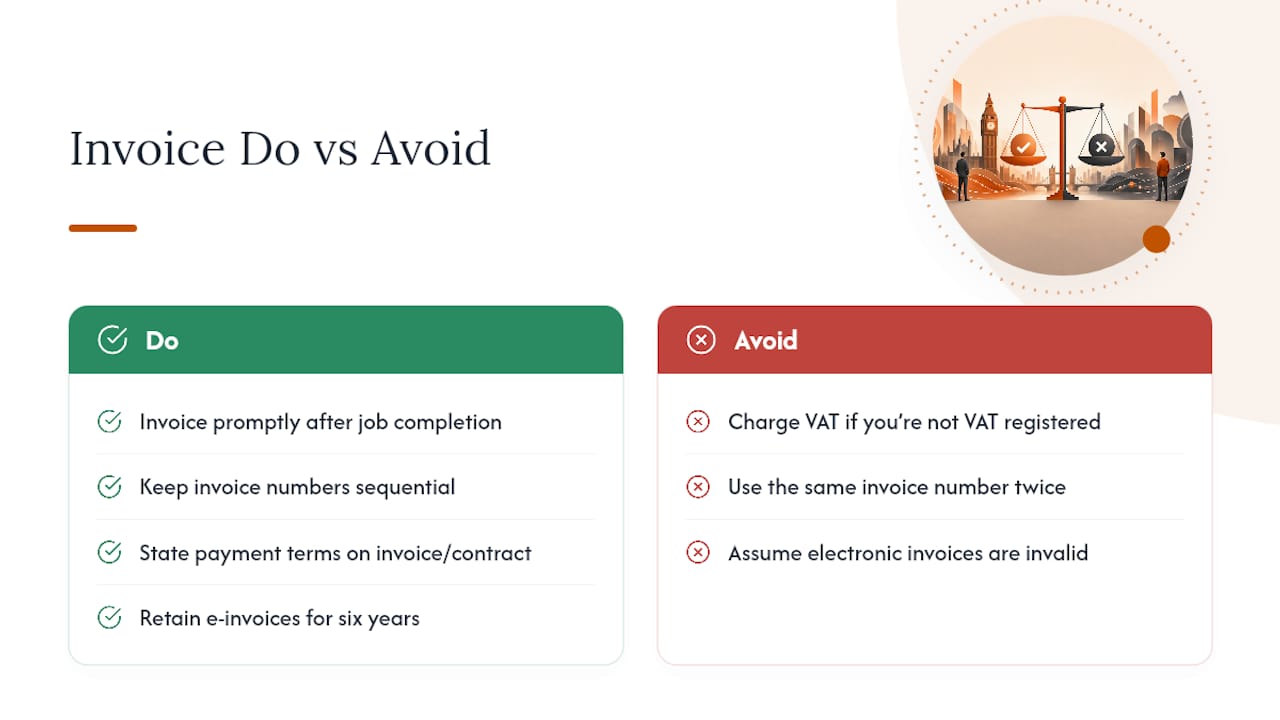
Do electronic invoices count as valid VAT invoices? Yes, provided you can demonstrate their authenticity, integrity, and legibility for the full six-year retention period.